
Introduction : Tamil Nadu Building Registration field Inspection
When registering a house or building in Tamil Nadu, documentation is not the only important factor. Building valuation and the basis used for calculating registration charges can also play an important role.
In certain situations, officials may conduct a physical field inspection to assess the building and verify its valuation. Particularly for higher-value buildings, such inspections could sometimes add time to the property registration process.
Recently reported changes in the Tamil Nadu Registration Department’s procedures aim to streamline the process by reducing unnecessary delays where appropriate valuation documents and other required details are available.
However, buyers and property owners should understand that the new framework does not simply mean that every building below ₹5 crore will automatically be exempt from field inspection.
The applicable procedure can depend on the building value, built-up area, valuation documents, undertakings and other conditions.
What Has Changed in Tamil Nadu Building Registration?
Under the new framework, the registration process may vary depending on the value of the building, its area and the valuation documents submitted.
One of the important thresholds being discussed is Rs.5 crore.
However, this should not be interpreted as:
«“No building below Rs.5 crore will ever require field inspection.”»
Instead, the applicable valuation and inspection procedure depends on the property’s category and the conditions specified in the applicable Registration Department instructions.
For property owners, the key takeaway is that having the correct valuation documentation ready before registration can help make the process smoother.
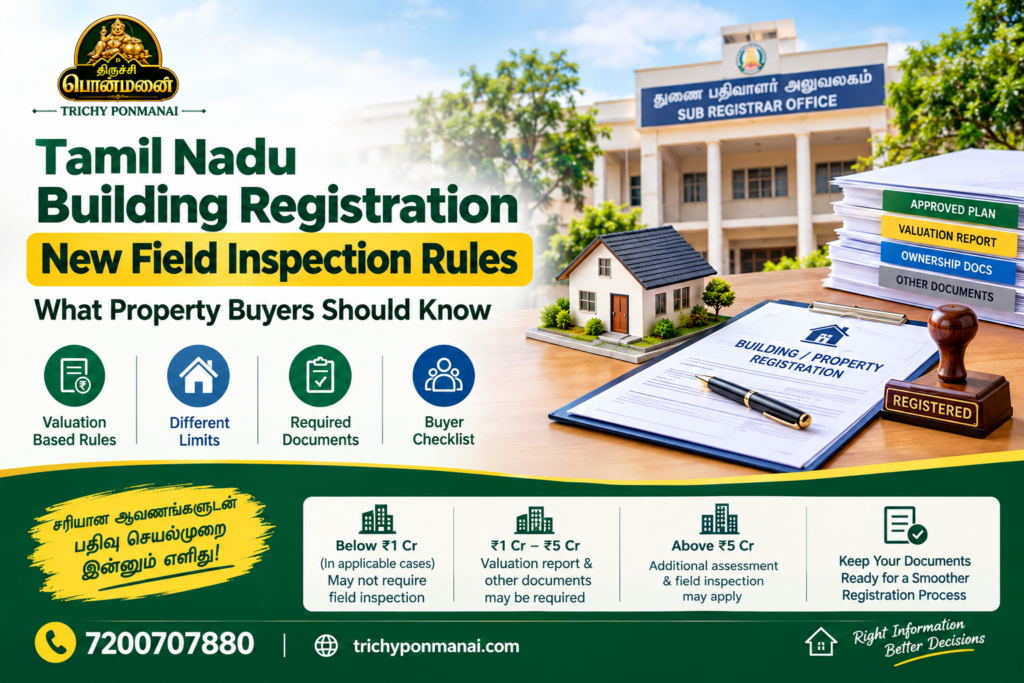
Buildings Valued Below Rs.1 Crore
Subject to the applicable conditions, buildings valued below ₹1 crore may be assessed using self-certified building valuation or applicable Public Works Department rates and other permitted valuation methods.
Where the required undertaking and valuation details are properly provided, the registration process may be completed without a physical field inspection in applicable cases.
The objective is to reduce delays caused by physical verification where it may not be necessary.
Property owners should nevertheless confirm the current requirements with the concerned registration authorities before presenting the document.
Buildings Valued Between Rs.1 Crore and Rs.5 Crore
This is an important category under the new framework.
For buildings valued between Rs.1 crore and Rs.5 crore, an approved or certified valuer’s valuation report and other prescribed documents may be required.
Therefore, property owners in this category should prepare the necessary valuation documentation in advance.
Having a proper valuation report and supporting documents can help avoid unnecessary delays during the registration process, subject to the applicable rules.
Buildings Valued Above ₹5 Crore
For buildings valued above ₹5 crore, additional valuation, assessment and field-inspection procedures may continue to apply.
Certified valuation reports and the prescribed official assessment process can become particularly important in such transactions.
Therefore, ₹5 crore should not be understood as the complete end of all field inspections. It is better understood as an important threshold within the revised valuation and inspection framework.
Why Is an Approved Building Plan Important?
An approved building plan can be important when establishing the building’s built-up area, approved dimensions and other relevant details.
Property owners should therefore check the following before proceeding with registration:
– Approved Building Plan
– Building-related approvals
– Property ownership documents
– Valuation-related documents
– Other documents required for registration
Keeping these documents organised in advance can make the registration process more predictable.
What About Resale Apartments?
For certain transactions involving already constructed apartments or flats, including some second or subsequent resale transactions, specific provisions or exemptions relating to building field inspection may apply.
However, this depends on the nature of the transaction and the applicable rules.
Therefore, buyers should not assume that every resale apartment is automatically exempt from inspection.
It is safer to confirm the current procedure with the concerned Sub-Registrar Office before registration.
Does This Apply to Vacant Plot Registration?
This is an important clarification for property buyers.
The current discussion is primarily related to building valuation and building-related registration field inspection.
Therefore, buyers purchasing a vacant residential plot should not interpret the ₹5 crore threshold as an exemption from plot approval or plot registration requirements.
For a vacant plot, buyers should separately verify:
– Title and ownership
– Parent documents
– Patta
– Encumbrance Certificate
– Layout approval
– Planning permission, where applicable
– Local-body approvals
– Road and access details
– Other applicable approvals
In other words, building field-inspection rules should not be confused with plot approval requirements.
What Should Property Buyers Check?
A property registration process becoming easier does not mean that property due diligence should be reduced.
Before purchasing a property, buyers should consider the following:
1. Title Clarity
Is the seller the legal owner of the property?
Are the parent documents and ownership history clear?
2. Approvals
Does the property have the required planning and local-body approvals?
3. Building Documents
If a building already exists, are the approved building plan and related documents available?
4. Valuation
How is the building or property valuation being determined for registration purposes?
5. Registration Charges
On what valuation are stamp duty and registration charges being calculated?
6. Latest Registration Rules
Registration procedures can change from time to time.
Before presenting a document, buyers and sellers should confirm the latest requirements through the Registration Department or the concerned Sub-Registrar Office.
How Can These Changes Help Property Owners?
The main objective of the revised framework is to streamline the registration process.
Where the required documents and valuation details are properly prepared, the possibility of delays caused by physical field inspection may be reduced in applicable cases.
This could make the registration process more predictable for both property owners and buyers.
However, the exact procedure will depend on the property’s value, category and the conditions prescribed under the applicable instructions.
Frequently Asked Questions
Is field inspection completely removed for buildings below Rs.5 crore?
No. It should not be interpreted as a blanket exemption.
The applicable procedure can depend on valuation, documents, property category and other prescribed conditions.
What happens when the building is valued above Rs.5 crore?
Additional valuation, assessment and field-inspection procedures may apply depending on the applicable rules.
What is the benefit of having an Approved Building Plan?
An approved plan can help establish the building’s approved dimensions and built-up area, which may be relevant to the valuation process.
Does this apply to vacant residential plots?
The building field-inspection framework should not be treated as a blanket exemption for vacant plot registration.
Plot buyers still need to independently verify title, layout approval and other applicable requirements.
When were these changes announced?
Reports regarding the new procedures began appearing on 10 September 2026. Subsequent explanations have referred to Rs.1 crore and Rs.5 crore thresholds and valuation-report requirements.
The exact applicability should be confirmed against the latest official Registration Department instructions before registration.
Conclusion
The new building field-inspection framework in Tamil Nadu is an important development for property owners and buyers, particularly for transactions involving building valuation.
Where the required documents and valuation details are properly prepared, the revised process may help reduce unnecessary delays in applicable cases.
But property buyers should remember one important point:
An easier registration process does not mean that property due diligence can be reduced.
Before purchasing a property, buyers should carefully verify the title, approvals, valuation, documents and current registration requirements.
For buyers researching property opportunities in Trichy, understanding such regulatory changes can help them make better-informed decisions.
Trichy Ponmanai aims to provide property-related information that helps buyers understand important aspects of property purchase and make decisions with greater clarity.
«Note: Registration rules and departmental procedures may be updated from time to time. Before registering a property, always verify the latest Registration Department instructions and the requirements of the concerned Sub-Registrar Office.»